

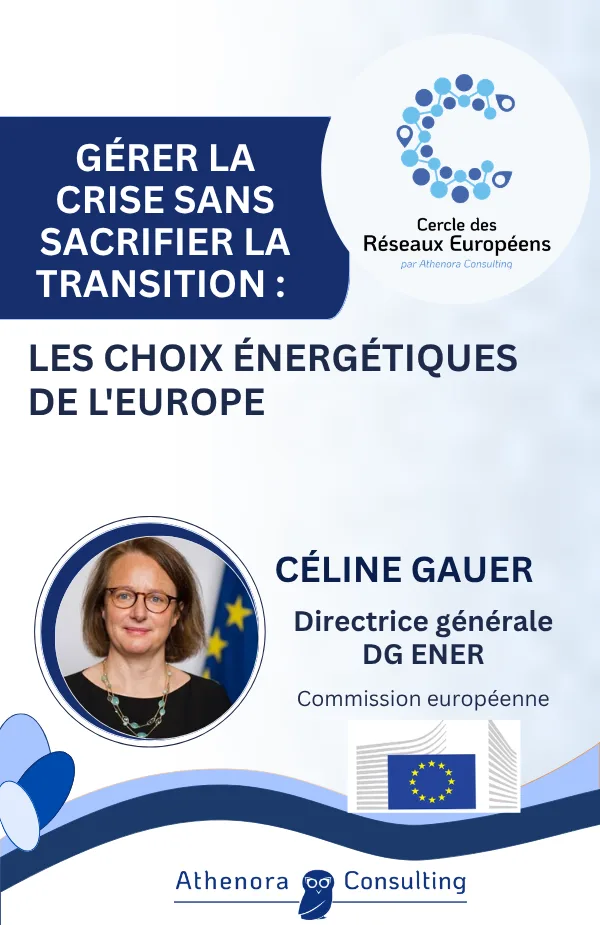
Managing the crisis without sacrificing the transition was the central theme of our discussion with Céline Gauer, Director-General of DG ENER, during the Networks Circle luncheon.
The crisis (fueled by successive crises) must not derail Europe from its climate trajectory. On the contrary, it demonstrates its necessity.
Managing the Emergency Without Losing Course: Rising prices, winter preparations, geopolitical tensions: crisis management is a major focus. But the crises of 2022 and today share the same origin: an over-reliance on imported fossil fuels. Emergency measures provide short-term protection. Only the transition offers lasting security. The objectives remain the same: security, affordability, and sustainability—three mutually reinforcing dimensions.
Enhanced European coordination: Member States retain their energy choices but are increasingly working together to address crises. This collective dynamic, exemplified by the EU Task Force, enables more agile management and a shared vision, essential for making collective choices that will shape the future.
Electrification, a pillar of energy independence: Driven by renewables and, depending on national choices, by nuclear power, electrification is key to reducing our vulnerability to external shocks. It requires grids adapted to growing demand and more diverse energy sources. The Grid Package, developed through co-decision, along with the development of storage and flexibility, are central to this undertaking. It also demands efforts in interconnection.
Competitiveness and energy efficiency: 60% of industrial fuel demand is already technically electrifiable. The challenge remains cost. Energy efficiency, still underestimated, is a key driver of competitiveness.
The Energy Union, a grand political vision: In line with the Draghi report, pooling resources remains a priority: interconnections, cooperation between states, diversification of partners for critical minerals, innovation for the benefit of the grid...
A clear course for 2040: This course is an essential signal for investors and businesses. The post-2030 framework is built around a shared priority: reducing the share of fossil fuels by leveraging all low-carbon solutions. Renewable gases, joint procurement, a future hydrogen strategy, a fusion strategy: each building block contributes to this trajectory.
At its core, an unwavering conviction: Every step towards the transition is also a step towards our energy security and competitiveness. Staying on course is already a response to the crisis.