

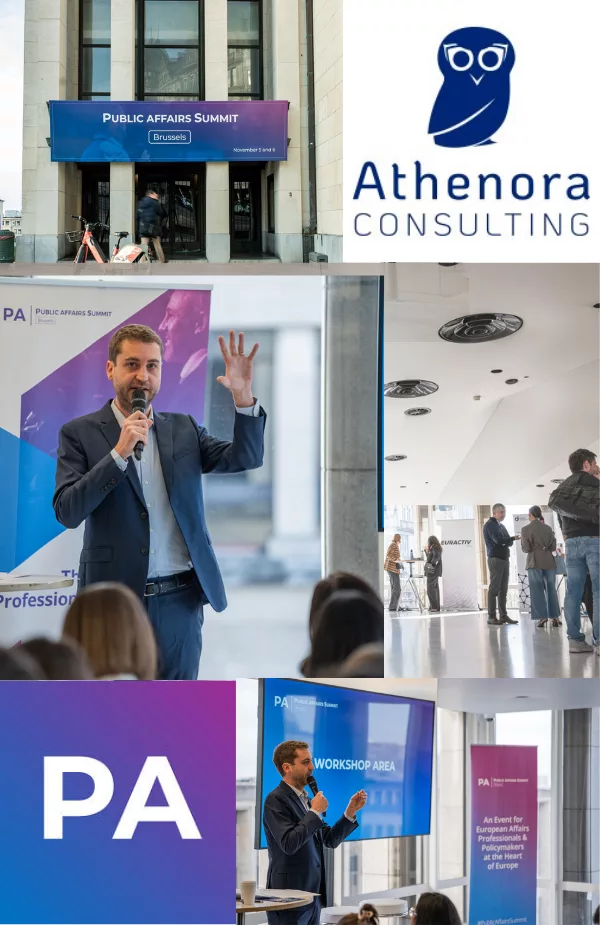
During the Public Affairs Summit, Thomas Dorget guided participants through the shifting balance of power within the EU with clarity and depth.
His central message? The redistribution of influence between the Commission, the Parliament, and the Council is reshaping the daily work of public affairs professionals. Agility and political understanding have become the new currencies of influence.
After years of overlapping crises — Covid, Ukraine, energy shocks — “crisis mode” has become institutionalised, with major consequences for decision-making and action levers.
Three key takeaways:
🔸 A Presidential Commission:
Ursula von der Leyen’s highly centralised leadership has concentrated power within a small inner circle. For lobbyists and consultants, true influence now demands proximity, precision, and patience — knowing when and how to reach the right level of the executive.
🔸 A Fragmented Parliament:
The 2024 elections left a chamber of shifting alliances. With no stable grand coalition, every file is a fresh negotiation. Influence now lies in coalition-building, tactical recalibration, and political dexterity over predictable patterns.
🔸 A Multipolar Council:
The Paris–Berlin axis no longer defines Europe’s direction. Power is now multi-capital: Rome, Warsaw, Madrid, and The Hague increasingly shape outcomes. Understanding national contexts is as vital as mastering Brussels’ institutional mechanics.
Today, the EU governs like an executive, deliberates like a coalition, and negotiates like a marketplace.
In this landscape, influence follows agility.
At Athenora Consulting, we see this as both a challenge and an opportunity — to help our clients decode complexity, anticipate shifts, and engage effectively where decisions truly happen.